Friday, August 5, 2016

Summer 2016 Day 32

With fewer supplies than we’d had two weeks earlier, we were able to portage in four trips. There and back, three miles, all told, twelve. We also took some time to poke around the top of the waterfall, pick some blueberries, and look just a short ways up the forest road for Simone’s house. We didn’t find it, and our dreams of a hot shower and a warm bed were disappointed.
At the top end of the portage, a bunch of girls pulled up in canoes, single-handedly carried them around the waterfall, and put them back in 100 meters below. Each canoe had a waterproof plastic barrel in it, and the second girl, not carrying the canoe, took the barrel.
Not having to worry about the current, only the rapids, they were able to break their portage up into a few quick leaps. With barrels ready, they didn’t have to unpack and pack.
We spoke with one of their trip leaders. They paddled down the river as part of a summer program. They had notes about the river ahead of us, and shared. They were having the time of their lives.
We didn’t have long before Shabbat, but we could still paddle the few miles to the next portage and spend our day off there  Across the river from our put-in, we saw a shack with tarp walls, a solid tree-trunk frame, and a wood stove.
We pulled up at Simone’s house. We found the door open, but no Simone. The sinks didn’t work, but we followed the pipes to a stream a short distance away and refilled our water. Pitching our tent in his yard, we waited to meet our host.
Over Shabbat, the rain came down hard. While our tent stood warm and dry, Simone’s cabin, by comparison, offered luxuriant shelter. We never met him, but were very grateful for his unlocked kindness.
Summer 2016 Day 32

Thursday, August 4, 2016

Summer 2016 Day 31

The river flowed smoothly through a clear, sunny, summer day. Despite the beginning of August, and the heat dome we’d read about encompassing the U.S., each day, northward bound, the temperature cooled a bit more.
We paddled around an island to the left. Once passed it, we looked back at the side we skipped and saw a column of smoke rising from a campfire, so we paddled back to investigate.
A young boy ran to get his dad. Danny came, and helped us ashore. He showed us around, introduced us to his family, and gave us a flag as a gift. In exchange, I gave him a card. Danny was an Atikamekw public relations worker in Montreal, visiting the country cabin he’d built for a few days. He’d started learning English a few weeks earlier and spoke it fluently.
He taught us how to say hello (“quay”), goodbye (I don’t remember), and the real name of the river in Atikamekw. He explained the symbolism of the flag. A circle represents the importance of unity. Four directions represent the four elements, and the different parts of a whole person: physical, psychological, emotional, and spiritual. North is for the children, east for the young, south for the old, and west for the dead, which being in a circle, is not the end. Three stars represent all Atikamekw Nehirowisiw Communities, Wemotaci, Opitciwan and Manawan.*
He told us his friend Simon lived in a shack not too far up river, and he’d be happy to host us.
With the flag tucked away in a hatch, we continued northbound. Six months later I’d have this flag displayed prominently in my home.
Then, just south of Rapides de la Chandier, the current grew too strong and we had to portage. A forest road ran along the west side of the river, and our put-in, at the top of the last remaining waterfall on the St. Maurice, lay a mile and a half up-hill.
While we ate dinner, a group of seven our eight First Nations canoes paddled down the river. We called out to them “quay” and waved.
Bear bagging is hard.

*This may be the most educational I’ve ever tried to be.

Summer 2016 Day 31

Wednesday, August 3, 2016

Summer 2016 Day 30

After rising from our soft mattress, our hosts drove us to our boats with all our gear.
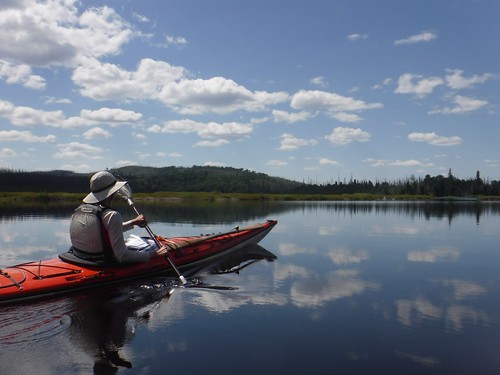
The river flowed noticeably against us, but we made steady progress.  With slightly less draft, Erin paddled over some shallow sand that I went a couple hundred meters around.
A small pike escaped my line just before I pulled it in.  Later, we snagged a big one.  I pulled the beast out into Erin’s boat.  Excited by the enormous dinner we’d have that evening, Erin held the slippery, scaly, muscular giant, while I worked to pull the hook from its jaws.
It writhed, and snapped free, then flopped out of the boat.  Still hooked, I tried to pull it  back up, but it bit the line, and swam free.
So big.  So tasty.  So gone.
The current grew stronger as we worked our way up-stream.  A burnt or logged forest stood behind a sandy steep shore.  A road without traffic ran along the top of the water-edge, steep incline.  On the left, we paddled past thick trees.
A bear crossed the river.  At first we thought we saw a log.  But then we got close.  Without a doubt, a bear swam across the river, working hard against the current, not quite as agile in the water as a kayaker.
Erin wanted to hug him.  He did look huggable.  No hugging took place.
He climbed out of the water on the left shore, bolted up the incline into the woods and disappeared.
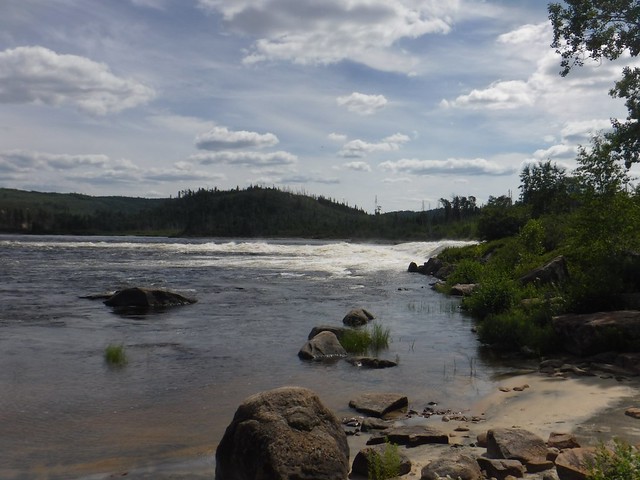
Farther upstream we arrived at rapids.  I barely pushed through.  Near the top, as I leaned into a hard turn, so as not to be thrown back down during my final sprint, my shirt caught on my fishing hook.  I had to ignore it or lose my progress.  As I swung my body around for another stroke, the hook tore free, taking part of my shirt with it.  
Erin couldn’t make it up the rapids.
I waited at the top, while she tried again and again, and failed.  I found a path leading down to the river.  If it was man-made, I might find a portage for her.  If it was bear made, I might find a bear.  I found neither portage nor bear.  When I came back down, Erin worked fiercely on the far side of the river.  She made it.
Reunited, we continued on.
We’d planned on staying in Qinze Milles for the night.  We didn’t know what we would find, but on our map, the name of a town marked the intersection of two forest roads.  
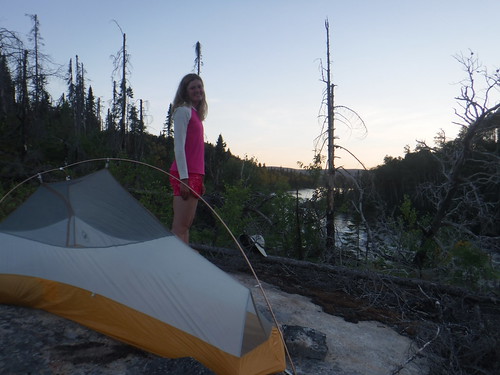
We found a campsite down by the water.  We followed the roads for a ways through the woods.  Erin called the moss that carpeted the forest, “elk moss.”  Or at least, that’s what they call it in Norway.
A fat rabbit hopped through the woods.  We didn’t see any Elk.  Trees lay fallen across the old forest road.
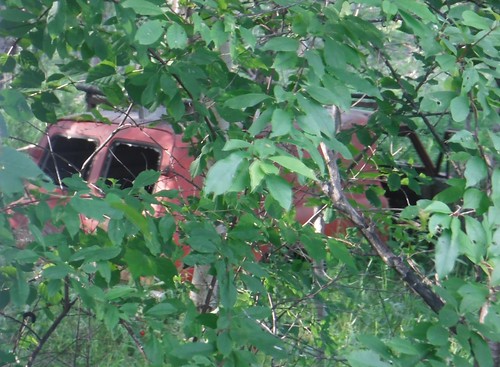
An old van lay abandoned in the woods.  Someone had started to build a shack near our campsite.  A metal cot with no mattress, and a steel wood stove rusted near the water.
We decided to bear bag our food.  I tied our pulley and some carabiners to the end of the rope to give it some weight, and then threw it over a high tree branch.  Or at least, I tried to throw it over a high tree branch, but it got stuck up there.
Erin and I looked up.  We yanked on the rope, it didn’t come down.  Erin tried to climb the tree, but didn’t find enough branches.  We tried to pull at the rope from lots of different angles, but our pulley and carabiners were still stuck up there.
We tied a rock to the other end of the rope, threw it over the branch (succeeding only after many tries), and pulled the whole business down from the other side.
It’s a good thing the other end of the rope didn’t get stuck up there.
The mosquitoes came out, and our fishless dinner burned a little while we worked on the bear bagging.  When we got into our tent, mosquitoes swarmed in with us.  We tried spraying them with mosquito repellent.  For the rest of the night, the tent stank of toxic fumes.
A critter made noise just outside.  Bunny or bear?  I didn’t know.

Summer 2016 Day 30

Tuesday, August 2, 2016

Summer 2016 Day 29

We began our day by carrying our things along the road around the dam.  We took the boats on the cart, and switched off with hauling because even with the wheels they got heavy.  We filled the duffle bag with dry bags, hauled it the distance, and then returned with it to the take-out for another load.  
The heaviest bags we carried separately from the duffle, one in each hand.  We’d stopped to rest and eat raspberries along the way.
The dam had not been marked on our map and the shape of the river changed since its construction.    We found dead ends and worked our way back around islands and through swiftly flowing passages before approaching a large bridge across the river.
To our right, a group of First Nations people sat in the woods near a giant birch bark canoe.  We waved.
Under the bridge, the current flowed strongest, but with a little heaving we made it up the river.  
The Atikamekw town of Wemotaci lay to the right, according to the map, along the water.  But we didn’t see any houses, let alone docks to take out at, just woods.  At one point, through the woods, we saw some large commercial buildings.  We couldn’t make out what they were.  We passed what looked like a path down to the water that continued  through tall grasses in the river.  Not ideal, we kept going.
We turned around a corner and saw the shore stretch out ahead.  Aside from a single house above a low cliff, we saw only woods.  We turned back around the bend and took out at the path.  We found some picnic tables in a field behind a school, closed for the summer.
Richard told us we’d need to ask permission to be in the First Nation’s town, and wrote us a note asking. The Atikamekw people have preserved their native language, and were taught French in school.  Very few of them speak English.
But we found a local, showed him our note asking for permission to stay, and were given an affirmative nod.  We then set out for a supermarket, wifi, toilet paper, and water.
The town had a small market.  We bought pasta sauce, vegetables, and ibuprofen for my swollen elbow.  We tried to buy a single roll of toilet paper, but they wouldn’t sell us one, only a bunch.  We asked if we bought a bunch, could we then return the rolls we didn’t need.  Maybe they could be given to other customers.
The manager said no.  She gave us a roll from their bathroom.
The reserve had houses and paved roads like other small towns do.  Perhaps the houses seemed a little more mass produced than most.  
A drunk spoke to us for a while, but we didn’t understand what he said.  He managed to ask for weed in English.  We didn’t have any.
A white psychologist visiting the community gave us the community center’s wifi password.  And while Erin and I caught up on the events of the world and communicated with our families, a local kid, Estobon, who spoke English, introduced himself.
His mother, Atikamekw, grew up in the town.  His father, French Canadian, grew up in Trois Rivieres, and worked for the Canadian forestry service based on the reserve.  With their pickup truck, we moved our more valuable gear to their house where it would be safe for the night. We then settled in to sleep in their guest trailer.
We showered, enjoyed hot tea, warm beds, and generous hospitality.

"https://www.google.com/maps/d/u/0/embed?mid=1NIJL0BU9OMyxiuy82HwV2j-kvrk" width="640" height="480"> Summer 2016 Day 29

Monday, August 1, 2016

Summer 2016 Day 28

For breakfast, at the top of our cliff, we had oatmeal piled with fat blueberries.  Then we began looking for the trail. We did not find it at the top of the cliff.  We double backed on foot toward the beach where we’d almost lost our boats, and didn’t find it there either.
We found the trail at the bottom of the cliff, just upstream of where we took out.  The shelf at the top of the cliff descended gradually.  A clear trail cut around, over, and under the dead trees and through the blueberry bushes at the bottom of the hill we’d  camped atop.
Trees had overgrown part of the trail, so we broke branches off.  A tree with all its branches, in the unburnt forest at the put-in,  lay across the path near the end.  We broke it, cut it, and cleared the way.
The six back and forths, ups, downs, and overs, made the portage exhausting work that took half the day and all of our energy.
Once finished, we rested for about 15 minutes, and then launched, pushing our weariness away.
Before long, we were at another portage.  As we unpacked our boats on the beach, a couple of young French-speaking guys paddled around the corner in their canoe.  They’d paddled down from the Goin Reservoir, one of our way points, and were as excited to exchange pleasantries as we were, though they spoke almost no English.
The river fell over a shelf in a spectacular display of hydrotechnics.  From the bottom to the top of the shelf, we portaged a short 100 meters, and then got back on the water.
We ended our day at the bottom of a dam, Chute Allard.  A kilometer portage waited for us the next morning, but at least it was on a flat gravel road.  We’d be able to use our cart.
And we found one of Richard’s stripped birch trees, beside a campsite and teepee under construction.
The exhausting first portage of the day, followed as it was by paddling and another portage, left me nauseous throughout the evening.  That night, though Erin insists it wasn’t that cold out, I shivered and froze like I’d never been colder.
Summer 2016 Day 28

Sunday, July 31, 2016

Summer 2016 Day 27

We had a little bit of portage left for Sunday morning.  With a few more back and forths, we were on the water by eleven.  Richard hoped to see us off, helped us with some of the gear, and was only a little surprised by how long it took.
With all of our supplies, portaging took about five heavily laden trips, followed by packing the boats from scratch.  I took my shoes off at the end and threw them into the cockpit.  Ordinarily I would have put them in a hatch, but with such a late start I rushed past that.
We said goodbye to Richard and set out.  After twenty minutes, feeling around inside of my boat, I discovered I only had one shoe in there.  We paddled back to the put-in, and looked around for the missing shoe.  Richard came down from the tracks, he’d been waiting for his train.  He hadn’t seen my missing shoe.  I’d lost it.  Richard tried to give me his shoes.  I couldn’t accept.
Going forward I’d wear my booties.  When dry, they weren’t so bad with socks.
We put back in and headed up the river.  We paddled up a tiny first current with a push and past a sacred first nations island.
Then we got to the second set of rapids.  No matter how fiercely I sprinted, I could not climb up the falling water.  We got out, and carried our boats over some rocks on the right side of the river.
For the third, and final set, we saw the cliff that Richard told us to portage up.  At the top, as he described, stood a cross remembering the loggers who had tied in these rapids.
We tried paddling through the current to the cliff.  The force of a jet off a rock swung my bow into the main current, and in a moment, the river pinned me sideways, my bow against one rock and my stern against another.
With all my might, the strongest of strokes and the most dexterous of hip wiggles, I could not free myself.  When I tried too hard, the river scuked me down, and I skulled for my life and stayed upright.
Erin watched from a short distance up river.  Neither of us had any idea how she could help.
Without any other ideas coming to mind, I got out.  The current raged around me, but I held onto my boat, and found I could stand.  I pulled my boat free, and we convened on a beach a short distance downstream
We began searching through the woods for a path to portage to the base of the cliff.  We found some paths, that seemed to go in various directions, but they always turned into nothing.  A fire had rushed through the forest a few years earlier, and left all the trees burnt out husks, some ready to fall with the slightest push.  
The sun shined down, passed the dead branches, onto a field of fallen trunks and blueberry bushes.  As we walked and climbed through the maze of fallen trees, we snaked through an endless supply of blueberry deliciousness.
We didn’t find a path.  We returned to our boats.  The water had risen and they floated, tangled in fishing line, caught in water weeds. We ran toward them, and then began the arduous work of untangling them. We’d grown used to the slow, meticulous process of untangling the line.  It frequently caught on weeds and formed knots, and nothing could be done about it except cut it, though we didn’t have enough, or untangle it.
We put back in the water and headed upstream again.  When we got to the spot where I’d been pinned, we got out and pulled the boats up stream along the side.  The current soon became too strong and the water too deep.  We needed to pull the boats over rocks.  We tied one boat, and carried the other over.  Then worked together to get it to the bottom of the cliff where we tied it to more rocks.
After repeating the process with the second boat, sometimes chest deep as we scrambled up the river, we were ready to begin our ascent of the cliff.  First we double checked that the portage wasn’t on the bottom of the cliff.
We climbed the cliff and set up two ropes at the top.  One to climb, and one with a pulley for the boat.  We scouted out the top of the hill, and didn’t find the path.  But Richard told us it would be up there, and we found some good candidates to search more thoroughly in the morning.
At the top of the cliff we found a small ledge before boulders, brush, and more cliff.  It seemed like the portage started there, so we hauled everything up.  We did not find quite enough room to pitch the tent without fear of falling back down the cliff in the night, so we climbed the boulders to a field of blueberries, and pitched the tent on the bald top of the hill surrounded by blueberry breakfast.
With the river flailing below, and a view in every direction, we rested in the prettiest camp I’ve ever made.
Summer 2016 Day 27

Thursday, July 28, 2016

Summer 2016 Day 26

Our hosts from the night before told us there’d be good fishing beneath the rapids just ahead.  Our map showed multiple rough spots.  We’d have to portage and it would be a long one.  No roads, but train tracks did run through the wilderness beside the river.  If we couldn’t find a trail, we’d take the tracks, and try not to get hit by a train.
When we arrived, I paddled back and forth across the river beneath the lowest set of rapids trailing a line.  I didn’t catch any fish.  We found no sign of a portage on either side of the river.  Erin set out to search the left, and I the right.
My vision isn’t that bad without my glasses, but it’s not great either.  After climbing tree roots up a six foot vertical ledge, I set into the woods.  Moss spread out beneath the trees, over rotting logs and mounds, around pines and birch.  Fewer branches reached out where I stepped through the shade, more up above.  Islands of sunlight suggested I might find an abandoned road, or portage trail; animal tracks turned into nothing.
I hiked up along the river, away from it and back.  When satisfied that the portage must be on the other side, I got back in my boat and met Erin returning to hers.  She too found nothing.  She didn’t even find the train tracks, which the map said should be there.
We set into the woods together to find the train tracks.  We climbed a steep hill, hands pulled at trees and feet dug into moss and earth, or looked for secure perches to push off of.  From the top, we climbed down to a gully, then up again and through the woods.  The tracks lay only 100 meters from the river, but through a strange wilderness, it was a long way.
We walked north west  along the tracks.  Walking on train tracks is hard.  We had to change our gates to match the planks, or balance on the rails.  We searched for a path down to the water, anything to suggest that the canoeists we’d met coming down the river had portaged this way.
A train’s whistle howled in the distance.  We climbed off the track and waited.   And waited.  The rumbling grew closer; finally, it passed.  We climbed back down to the tracks and continued.  After a time, without any sense of how far we’d come, we headed back to the river to see if we’d passed the rough section.  We found more rapids and a strong current.  Nothing we could paddle up.  We hiked up and down the edge of the river before returning to the tracks.
Feeling a little hopeless, we continued west.  A bear lay in the tracks up ahead.
From our distance, we waved and yelled, raising our hands above our heads to shoo it off.  It stood, looked at us from its sunny resting place, and did not shoo.
We returned to our boats to look for a portage trail again on the other side of the river.
Erin found it.  A band of orange tape hung from a half fallen branch.  A barely discernable trail lay underneath.  We followed it.  Sometimes the trail blazed clearly.  Other times, we got lost, and then more lost, before finding it again.  The trail took us through thickly clustered pines, from which we could barely defend our faces.  It took us over several streams.  One had an old log bridge, another we stepped through.  Then, it became clear, beautiful, and well maintained.  The upper half, around the worst rapids, had seen regular use.  The lower half, around rapids one could paddle down but not up, lay abandoned.
Where the old trail and the new trail met, a third led away from the water into the woods.  Not far in, we found a cabin.  The door stuck, nailed shut, the windows boarded over.  A phone number had been written on the wall.  We couldn’t call it without reception, or for that matter, with a phone that didn’t work in Canada.
Beside the small cabin stood a work shack.  Rope hung from rafters beneath the sheet metal ceiling, and a pack frame hung from a nail on the wall.  The Vietnam military-era frame met  our portage needs perfectly.
We hiked back to the boats, tied to a root floating on the water, losing the trail a few times, and continued east to look for a place we could take them out of the water.  We chose a site where a small stream cut across the path and through the stubby waterside cliff.
We took our boats out, and began the portage to the nice trail, half the distance to the put-in under the railroad bridge.  Erin balanced the duffle bag on her head, because she’d seen people doing it in India and thought it a good way to carry things.  I had the pack frame on my back, heavy with as many dry bags as we could tie to it.  The rough straps dug into my shoulders.
With an additional bag in each hand, and Erin’s occupied with the duffel, nothing protected our faces from the tightly packed pines that tore at our cheeks and slapped at our eyes.
Eventually, we again found the nice trail, and at its beginning, a pretty little beach with a fire pit. By the time we’d arrived, with exactly the gear we needed to make camp, our day had ended.  We’d finish the portage tomorrow.
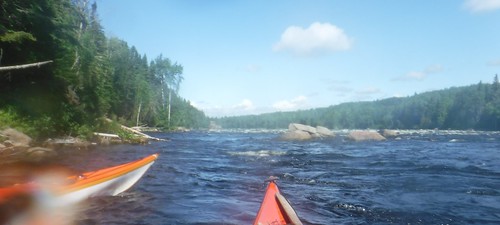
Resting beside our beach campfire, the rapids poured in front of us, and the air flowed with life.
Summer 2016 Day 26

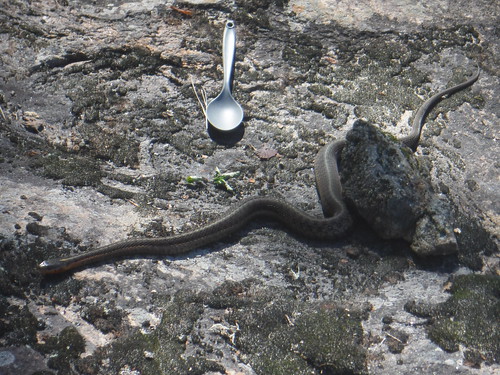
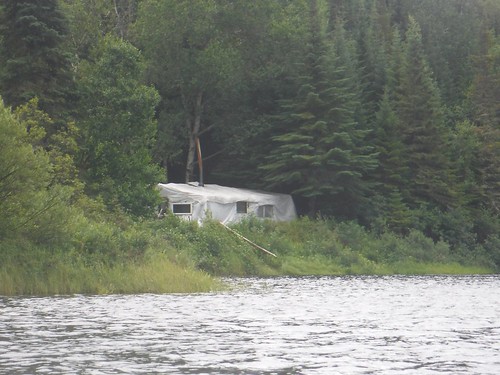
The next morning we scouted the trail into the forest.  Farther back we found a second shack with tarp walls protecting sealed plastic blue barrels.  Our trek into the woods eroded our hope with doubt.  We didn’t know what we might find around the next corner, but hoped it would be good.  The blue barrels didn’t quite make the cut.
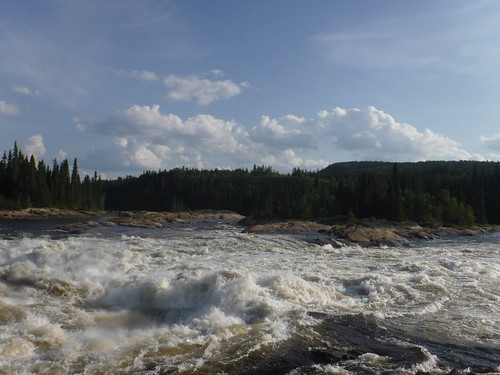
Back along the river, after crossing a few more streams, we found another campsite on a stone beach besides the biggest rapids yet.  A couple of fresh lemons, and an egg in the middle on a frying pan lay beside a grill.  Firewood sat under a plastic tarp.  The camper was nowhere to be found.  Farther up, we discovered the put-in beneath a railroad bridge.
We then went back down the bad trail, parts of it always new, parts of it always the same, and resumed our portage.  After our first run we met Richard.  He liked to spend the summer along the trail, and was largely responsible for its beautiful maintenance. He’d spent so much time alone lately, that he was as happy to meet us as we were him.
He helped us with our portage by lugging gear, and when we finished, just before the end of the day, he gave me a fishing lesson on a shelf, shallow in the deep rapids.
Over the Sabbath, he shared his food with us and told us a lot about the river up ahead, which he’d canoed extensively.
  • He said that at the next set of rapids, we’d have to climb a rock cliff to find the portage trail.
  • Losing our water filter was the best thing that could happen to us because all the water up there was great for drinking.
  • At the beginning and end of each portage, we’d find a birch tree stripped of its bark.  The natives did that in memory of the old birch canoes they used to paddle.  They’d strip the trees to repair their boats.
  • We could wave down a train on the side of the tracks and they’d stop for us.  That’s how he came and went from his semi permanent camp site.
  • We’d have to ask permission to enter the First Nations’ villages up ahead.  But once we did, they’d be super welcoming.  We’d just have to ignore the adicts.
  • He would give us whatever logistical help he could, including his hospitality in Montreal, at the end of our trip.

Summer 2016 Day 26b